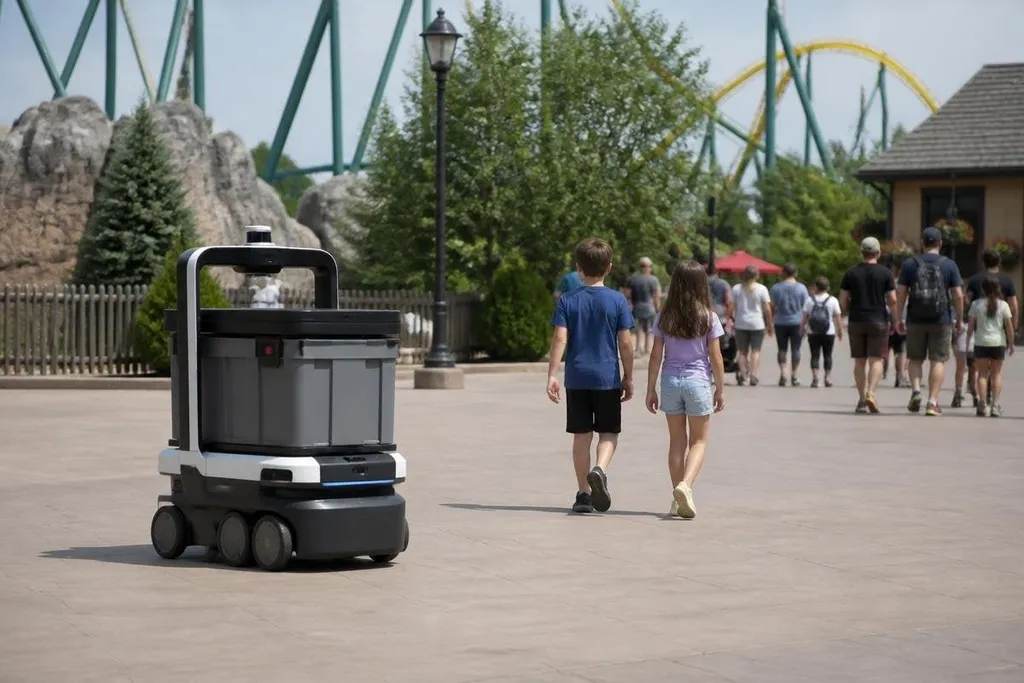
A theme park robot has to work around children, crowds, weather, noise, and strict safety rules. That puts the next step for park automation in machines doing one repeatable job well. Humanoid tricks can wait until parks have proved the basics.
- Guest contact: robots may guide visitors, answer routine questions, or run shows.
- Backstage work: machines can move supplies, inspect rides, or clean paths.
- Proof before scale: parks will need clear safety records and repair plans.
Where robots fit first
The easiest jobs to automate are away from the busiest guest areas. A mobile robot can carry food, spare parts, or cleaning supplies between fixed points, while staff keep control of unusual requests and crowded routes.
That division matters because theme parks change from hour to hour. A route that works before opening may become unsafe after a parade begins. The robot needs cameras, distance sensors, and a way for staff to stop it when people block its path.
Inspection is another useful job. A robot with cameras can check fences, walkways, service areas, or ride parts on a set schedule. It can record a fault for a technician to review, but a record alone doesn't fix a loose bolt or a damaged panel.
The same rule applies to cleaning. An autonomous floor machine may cover a known area on its own, yet staff still need to handle spills, wet surfaces, rubbish in its path, and sudden changes around food stalls.
Guest-facing machines need restraint
Robots that speak to guests will face a harder test. They need to hear questions over music and crowd noise, give correct directions, and hand off unusual requests to a person without making the visitor repeat the whole problem.
Guest-facing machines can work well when their task stays narrow. They can point toward a ride, read a posted wait time, or explain a safety rule from approved text. Open conversation is a different job, especially when a guest asks about ride access, a lost child, or a medical need.
Theme parks also need to decide how a robot behaves when it fails. A frozen screen, a blocked wheel, or a wrong answer should lead to a clear human contact, not a long loop of repeated prompts. Staff training matters as much as the robot's software.
A theme-park robot that stops after a wrong answer needs a repair plan, a staff contact, and a clear reset time. Dated reporting from Robot 24 can place those details beside the robot’s task, test setting, and human support. That standard matters most when parks compare robots for shows, where a missed cue is easier to fix than a service failure.
Shows will be easier than service
Entertainment gives parks more control. A robot in a scheduled show can move through a known space, follow a timed routine, and operate behind marked barriers. The team can test the same sequence before guests arrive.
That control doesn't remove the safety work. Designers still need safe stopping points, limits on speed and force, and a plan for a power loss. The robot's movements must also fit the story without blocking sightlines or creating a hazard near the audience.
A character robot that walks, waves, or speaks may become a useful part of a show. Its value will depend on uptime, repair time, and how much work staff must do between performances.
A machine that needs a technician after every short session won't help much, no matter how natural its face looks.
A buying checklist for park operators
Before a park signs a robot contract, the team should check:
- Task limits: Write down the exact job, route, hours, and objects the robot must handle.
- Human control: Test the stop button, remote control, and staff handoff during a blocked route.
- Weather limits: Confirm the rated conditions for rain, heat, dust, and outdoor storage.
- Repair plan: Ask who holds spare parts, who fixes the robot, and how long a repair normally takes.
- Guest data: Check what cameras record, where files are stored, and when the system deletes them.
- Failure test: Run the robot with a dead battery, lost network link, blocked sensor, and crowded path.
I'd back backstage transport and inspection before putting a conversational robot in charge of guest problems. The work is easier to measure, and a staff member can step in before a small fault affects a whole area of the park.
The next useful proof will be boring by design: a robot completing the same task across busy days, bad weather, sensor faults, and routine repairs. Until parks publish those results, the best place for many robots is a narrow job with a clear stop button.